Apologies a theme of cheesy song titles seems to be appearing! I left Ayacucho yesterday after the usual bus chaos. There seems to be some sort of unwritten rule which says that although all the seats on long distance buses are allocated and although there is a limit on how much luggage people can bring, there will be a great deal of pushing and shoving to get everything loaded. Also all the people going on the bus will stand outside it until the bus driver starts to edge forward as if he is leaving, at which point all the people will try and get on the bus at the same time jamming the doorway and shouting at each other. It's very entertaining to watch when you've arrived early for your bus and are peacefully waiting for it! Gives you something to do...
I´m now in Lima, which is wearing its winter time cloud cover, yesterday was a bit broken but today is very gray. However, I was surprised yesterday to be really pleased to be getting here. Most people when asked say, oh Lima, it's horrid and scary and gray and previously I would have agreed.
Sadly there's not much that the city can do about the gray bit as that's just winter time weather, but most tourists come in the winter because it's dry in the Andes where the major tourist attractions are. I think the horrid and scary judgements are probably a bit harsh. Most people come to Lima first, get picked up at the airport, experience some extremely hairy taxi driving, go through some very poor sections of Lima at night and it's their first experience of Peru. They decide that it looks dangerous and there's little attractive about it. After a couple of months here, it doesn't feel so different to the rest of the country just a big city and we're all more careful in big cities (seen the signs telling you to watch out for pickpockets in Piccadilly Circus?) At this point in my travels it's quite nice to be somewhere you can go to the cinema and hang out if you want to.
My hostal is entertaining called "Flying Dog Backpackers". I have no idea why. It's scruffy but clean and run by laid back, cool guys who are really helpful. It's also incredibly well located in the centre of Miraflores, which is a very nice part of Lima. So time out in the big smoke is proving more pleasing than I expected, but I'm looking forward to getting back to the mountains next week.
Friday, August 05, 2005


Wednesday, August 03, 2005
A long and winding road
Why think of a good title, when you can pinch one off someone else?
Last Sunday at 5:30am I was at the bus station in Cusco to get my stuff loaded on to the bus for Ayacucho. It was the beginning of a marathon bus journey, 22 hours to be precise! Now the distance from Cusco to Ayacucho as the crow flies is not actually that far but there are several reasons why it takes so long:
1) The bus is not that fast when it's running and during the early part of the journey it stopped twice - they managed to run out of petrol 20m from the gas station they wanted to fill up at, which resulted in lots of running about with buckets of fuel and hoses; the second time I don't know what the reason was but when they took the cover of the engine off inside the bus the whole thing filled with smoke! That took about 30 minutes to fix
2) The road is only tarmaced for the first four hours and once it gets dark the bus driver only has his headlights to follow the quite narrow, "afirmada" road.
3) The Andes are very tall, steep mountains and so the road spends a lot of time zig zagging up the mountain only to zig zap down the other side into a new valley, and repeat.... a lot
The plus side of all this is that you get lots of time to talk to your neighbour ( I was lucky I had two during the journey, one was an economist and one a lawyer, both working with rural populations, so we had interesting conversations. My Spanish was slightly pushed by the economist when I was trying to explain the role of the Queen in the British parliamentary system and how it works given we don't have a written constitution! I hope I haven't completely confused him).
You also get to look at the spectacular landscape and see country life going on. Basically it seems that the further you get from the towns the poorer it is, I guess because people can't sell things at market easily. The lawyer said that the land is fertile and v.good for producing potatoes but that transporting them to market is very difficult for people. And realistically I don't seem how you could farm this sort of land in the commercially intensive way that is normal in more developed countries, I have a nasty feeling you'd lose all the top soil.
The last half of the journey was in the dark (because we're reasonably close to the Equator the sun rises and sets at around 6) and bizarrely I found it easy to sleep all night and wake up when we got to Ayacucho. Why can't I do that on planes?
However probably my abiding memory of that journey will be 22 hours of a music form that seems very close to Chinese. To my unappreciative ears it sounded whiney and piercing! Fortunately it wasn't on very loud, but it was on the entire time.....
Tomorrow another bus journey, but this time just the 8 hours from Ayacucho to Cusco.
Last Sunday at 5:30am I was at the bus station in Cusco to get my stuff loaded on to the bus for Ayacucho. It was the beginning of a marathon bus journey, 22 hours to be precise! Now the distance from Cusco to Ayacucho as the crow flies is not actually that far but there are several reasons why it takes so long:
1) The bus is not that fast when it's running and during the early part of the journey it stopped twice - they managed to run out of petrol 20m from the gas station they wanted to fill up at, which resulted in lots of running about with buckets of fuel and hoses; the second time I don't know what the reason was but when they took the cover of the engine off inside the bus the whole thing filled with smoke! That took about 30 minutes to fix
2) The road is only tarmaced for the first four hours and once it gets dark the bus driver only has his headlights to follow the quite narrow, "afirmada" road.
3) The Andes are very tall, steep mountains and so the road spends a lot of time zig zagging up the mountain only to zig zap down the other side into a new valley, and repeat.... a lot
The plus side of all this is that you get lots of time to talk to your neighbour ( I was lucky I had two during the journey, one was an economist and one a lawyer, both working with rural populations, so we had interesting conversations. My Spanish was slightly pushed by the economist when I was trying to explain the role of the Queen in the British parliamentary system and how it works given we don't have a written constitution! I hope I haven't completely confused him).
You also get to look at the spectacular landscape and see country life going on. Basically it seems that the further you get from the towns the poorer it is, I guess because people can't sell things at market easily. The lawyer said that the land is fertile and v.good for producing potatoes but that transporting them to market is very difficult for people. And realistically I don't seem how you could farm this sort of land in the commercially intensive way that is normal in more developed countries, I have a nasty feeling you'd lose all the top soil.
The last half of the journey was in the dark (because we're reasonably close to the Equator the sun rises and sets at around 6) and bizarrely I found it easy to sleep all night and wake up when we got to Ayacucho. Why can't I do that on planes?
However probably my abiding memory of that journey will be 22 hours of a music form that seems very close to Chinese. To my unappreciative ears it sounded whiney and piercing! Fortunately it wasn't on very loud, but it was on the entire time.....
Tomorrow another bus journey, but this time just the 8 hours from Ayacucho to Cusco.
Saturday, July 30, 2005
Choquequirao
Or "Cradle of Gold" as the translation goes. This apparently is unlikely to be its original name but is one given to it locally and used for time immemorial. Once it gets on a map that's it.
What is she blethering on about I hear you asking yourselves. Ah yes, I've just come back from a 5 day trek to an Inca site called Choquequirao. Like Machu Picchu it is built on a ridge with spectacular views on both sides of the site. It has fewer uncovered high status buildings but is likely to have been a royal site (archaelogists have different theories) and may have been a country estate. It has vast quantities of unbeliveably steep terraces, more of which are still being uncovered and it will be some years before the entire extent of the site is known/revealed to the eye.
The other major difference to Machu Picchu is that the only way in and out is on foot or if you're feeling terribly lazy on horse/mule back (although even then you have to walk some of it because it is very steep and rocky). This means that the site is quiet, when we were there, on average we could see about 10 other people on the whole site versus the several hundred a day at Machu Picchu.
The trek itself is part of the whole experience, we walked a loop, 2 days to get to the site, a day at the ruins and 2 days to walk out. It's tough and there's lots of straight up and down and very narrow paths with extremely sheer drops, but it's an incredibly rewarding trek. The Apurimac valley is spectacular with jagged, snow capped mountains fringing it and a great green river thundering through it. The valleys that open off it are a little gentler with farms dotted about and a subsistence way of farming that was last used in England before the second world war. Horses, mules and feet are the methods of transport through the valleys. Oxen are used to plough, or on very steep slopes, manul ploughing. The local people speak Quechua first and Spanish second (or not at all). People are polite, welcoming and shy. When trek passes trek, every member says "Buenas Dias" to every member of the other trek, so a little chain of acknowledgement ripples through the lines.
I wondered a week or so ago if after this trip I would want to come back to Peru, would I have "done it all". After this trek I know I will come back, there are so many amazing places in the Andes and by walking you see them slowly and you get a little taste of a way of life and a strong culture that is different to ours.
What is she blethering on about I hear you asking yourselves. Ah yes, I've just come back from a 5 day trek to an Inca site called Choquequirao. Like Machu Picchu it is built on a ridge with spectacular views on both sides of the site. It has fewer uncovered high status buildings but is likely to have been a royal site (archaelogists have different theories) and may have been a country estate. It has vast quantities of unbeliveably steep terraces, more of which are still being uncovered and it will be some years before the entire extent of the site is known/revealed to the eye.
The other major difference to Machu Picchu is that the only way in and out is on foot or if you're feeling terribly lazy on horse/mule back (although even then you have to walk some of it because it is very steep and rocky). This means that the site is quiet, when we were there, on average we could see about 10 other people on the whole site versus the several hundred a day at Machu Picchu.
The trek itself is part of the whole experience, we walked a loop, 2 days to get to the site, a day at the ruins and 2 days to walk out. It's tough and there's lots of straight up and down and very narrow paths with extremely sheer drops, but it's an incredibly rewarding trek. The Apurimac valley is spectacular with jagged, snow capped mountains fringing it and a great green river thundering through it. The valleys that open off it are a little gentler with farms dotted about and a subsistence way of farming that was last used in England before the second world war. Horses, mules and feet are the methods of transport through the valleys. Oxen are used to plough, or on very steep slopes, manul ploughing. The local people speak Quechua first and Spanish second (or not at all). People are polite, welcoming and shy. When trek passes trek, every member says "Buenas Dias" to every member of the other trek, so a little chain of acknowledgement ripples through the lines.
I wondered a week or so ago if after this trip I would want to come back to Peru, would I have "done it all". After this trek I know I will come back, there are so many amazing places in the Andes and by walking you see them slowly and you get a little taste of a way of life and a strong culture that is different to ours.
Sunday, July 24, 2005
School's out for summer
Well I've officially had my last day of school. After four weeks I know what I don't know and that's a lot! It's been really good fun, hard work and frustrating at times but I can now talk to people, albeit slowly. I have a lot of grammar in my head but it is hardly intuitive yet, which leads to a lot of thinking and self editing when I speak. The number of words I know has gone up exponentially though and sometimes when a new word is described to me in Spanish I can understand what it's meaning is (sign language helps as well). I wish I understood the grammatical structure of English better as it would make understanding grammar in a new language easier! There are 3 forms of past (that I know in Spanish) and I think they all have English equivalents that I use without thinking about it!
I guess one measure of progress is that previously when I've been in South America I have carried my phrase book at all times. Over the last few weeks I haven't bothered to carry it at all and I've donated it to the South American Explorers Club, so it can find a useful home with someone else. I have however now got a medium size dictionary which was essential for class and which I will be carting with me over South America.
What I need to continue to do is talk Spanish a lot and I am a bit concerned that I won't as the international travellers language is English. But I really appreciate the effort that all those who speak other languages have put into learning them.
Now off to walk up some steep hills for 5 days to an Inca site called Choquequirao - pictures and itinerary are on the Chaska Tours site.
I guess one measure of progress is that previously when I've been in South America I have carried my phrase book at all times. Over the last few weeks I haven't bothered to carry it at all and I've donated it to the South American Explorers Club, so it can find a useful home with someone else. I have however now got a medium size dictionary which was essential for class and which I will be carting with me over South America.
What I need to continue to do is talk Spanish a lot and I am a bit concerned that I won't as the international travellers language is English. But I really appreciate the effort that all those who speak other languages have put into learning them.
Now off to walk up some steep hills for 5 days to an Inca site called Choquequirao - pictures and itinerary are on the Chaska Tours site.
Thursday, July 21, 2005
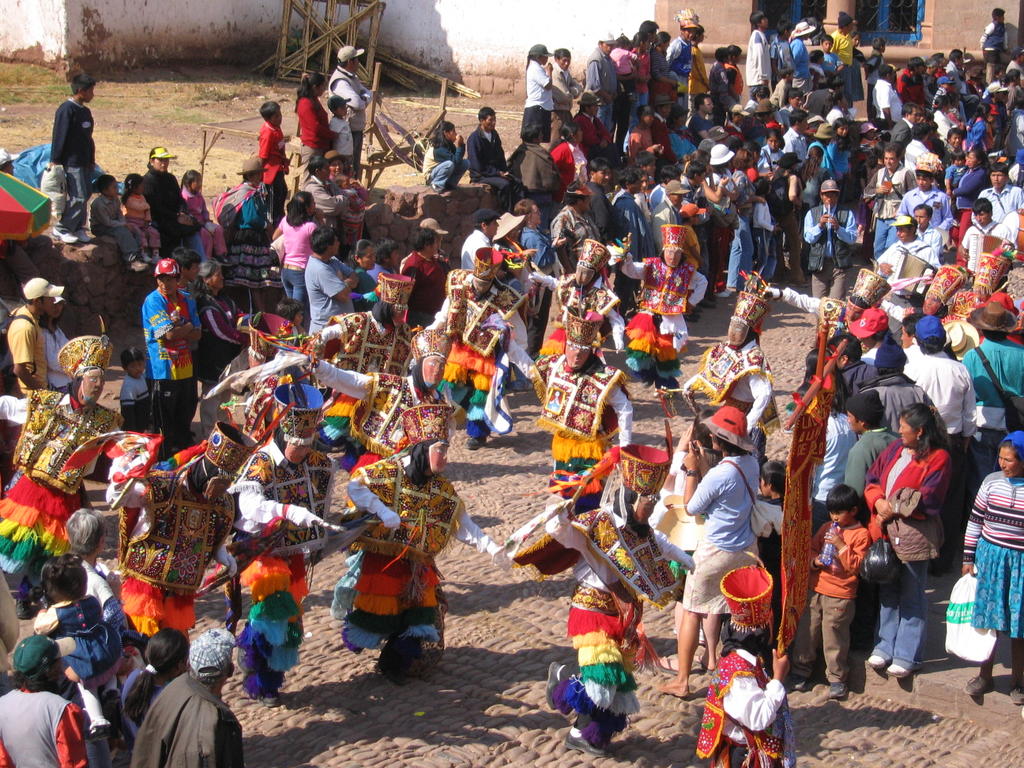
Last Saturday it was the fiesta of the Virgin del Carmen in a couple of places near here. Lisa and I (a fellow student) caught the bus over to Pisac and spent the afternoon having lunch and watching the procession of dancers and bands. Inadvertently we sat in a great place to see as all the dancers came round the square in front of us.
It was an amazing sight, over twenty groups of different dancers with specific costumes and different dances. All apparently from the same small town and surrounding area. I can't think of anything similar in the UK. It was a riot of colour and sound and only one of three days! We also experienced the Peruvian attitude to health and safety (there isn't really one). At various points arrangements of fire crackers were let off, mainly to make a noise I think. We were far to close to one early on, along with a load of locals. Unfortunately there wasn't really anywhere to run away too as the crowd was too big but we copied others and turned our backs to the explosion, shut our eyes and put our fingers in our ears! We learnt our lesson and stayed well away from the others that we saw!
Subscribe to:
Posts (Atom)